The Calm Departure Method


HOME ALONE
HAPPY DOG

$
38,97
$19,97
50% OFF
HOME ALONE, HAPPY DOG — Final eBook PDF
Complete Calm Departure Toolkit (120 $)Comprehends Six Bonuses
The Alone-Time Baseline Kit (20 $)
The Departure Trigger Map (20 $)
The Calm Departure Progress Ladder™ (20 $)
The Working Owner Survival Plan (20 $)
The Neighbor Peace Plan™ (20 $)
When Should I Get Help? (20 $)
Secure payment - Instant download

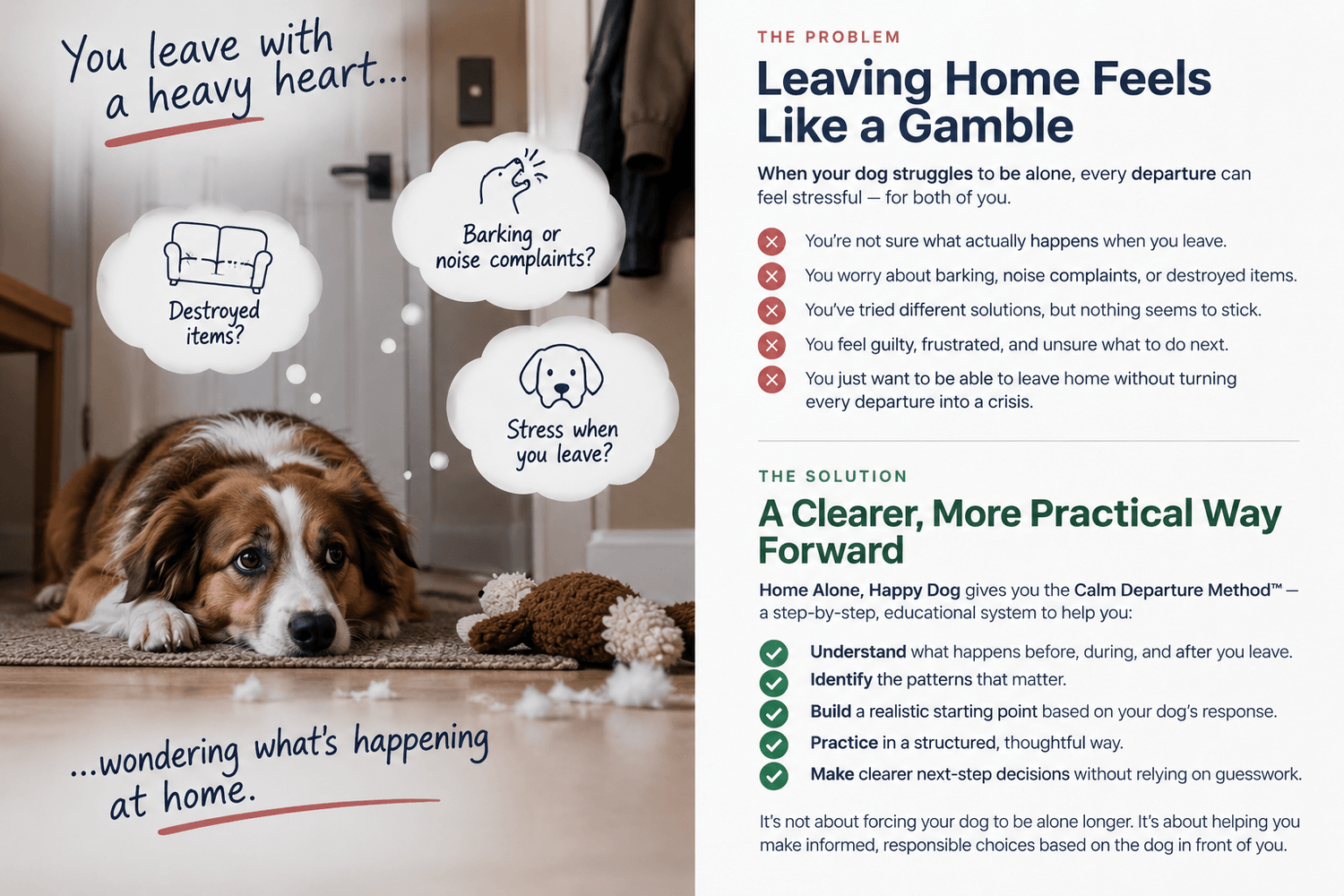

THE SOLUTION: A CLEARER WAY TO KNOW WHAT TO DO NEXT
The Calm Departure Method™ was created to replace guesswork with a simple, structured process.
Instead of trying another random tip every time a departure goes badly, you learn to work from what your dog is actually showing you.
The method helps you move through five practical steps:
1. OBSERVE
See what really happens before and after you leave.
Rather than relying only on barking, damage, or assumptions, you look at the full sequence of behavior.
2. MAP
Identify the patterns that appear around your departures.
Time of day, routines, objects, environmental noise, and the departure sequence itself can all provide useful context.
3. START
Use those observations to establish a practical starting point.
You are not trying to discover the maximum amount of time your dog can tolerate.
You are looking for a level that appears more appropriate for structured practice.
4. PRACTICE
Build gradual departure practice around your dog’s current response.
The goal is not to force longer absences.
It is to create a more thoughtful, repeatable process.
5. ADAPT
After each appropriate practice session, review what happened and make the next decision:
Repeat.
Progress.
Step Back.
Or Pause & Reassess.
WHY THIS FEELS DIFFERENT
Home Alone, Happy Dog doesn’t give you another isolated trick.
It gives you a framework for answering the questions that usually create the most confusion:
What am I actually seeing?
What pattern matters?
Where should I begin?
Is this level still appropriate?
Should I keep going, make it easier, or stop and reassess?
That means you can stop relying on guesswork and start making clearer decisions based on the dog in front of you.
THE GOAL
The goal is not to “beat the clock.”
The goal is to build a more organized, individualized approach to time apart — one that helps you better understand your dog, manage real life more responsibly, and know what the next step should be.
THE CORE PRINCIPLE
Don’t measure progress by the clock alone.
Measure it by your dog’s response.
Educational resource. Individual outcomes vary. Not a substitute for veterinary diagnosis, treatment, or individualized behavioral care.
HOW IT WORKS:
Home Alone, Happy Dog is built around one simple idea:
Don’t guess. Observe, understand, practice, and adapt.
Instead of following a rigid countdown or trying random solutions, you use the Calm Departure Method™ to understand what your dog is actually doing and make the next decision based on their response.
STEP 1 : OBSERVE
Start by seeing what really happens before and after you leave.
Use your dog’s behavior, your notes, and — when appropriate — video observation to understand the sequence instead of relying on assumptions.
STEP 2 : MAP
Identify the patterns around your departures.
Shoes, keys, work bags, time of day, environmental noise, routines, and other details may all provide useful context.
The goal is not to diagnose your dog.
The goal is to understand what appears to change and when.
STEP 3 : START
Use what you observed to establish a practical starting point.
Rather than testing how long your dog can “last,” you begin from a level that appears more manageable based on the information you have.
STEP 4 : PRACTICE
Use carefully structured departure practice.
Keep the process simple, monitor your dog’s response, and avoid turning every session into a test of maximum tolerance.
STEP 5 : ADAPT
After each appropriate practice session, review what happened.
Then choose the next responsible step:
Repeat.
Progress.
Step Back.
Or Pause & Reassess.
The method is designed to help you stop guessing and start making clearer decisions based on the dog in front of you.
THE CORE PRINCIPLE
Don’t measure progress by the clock alone.
Measure it by your dog’s response.
That means the goal is not simply to make every absence longer.
The goal is to build a clearer, more individualized process for helping your dog become more comfortable with appropriate time apart.
Educational resource. Individual outcomes vary. This product does not replace veterinary diagnosis, treatment, or individualized behavioral care.

HOME ALONE
HAPPY DOG
$
38,97
$ 19,97
50% OFF
HOME ALONE, HAPPY DOG — Final eBook PDF
Complete Calm Departure Toolkit (120 $)Comprehends Six Bonuses
The Alone-Time Baseline Kit (20 $)
The Departure Trigger Map (20 $)
The Calm Departure Progress Ladder™ (20 $)
The Working Owner Survival Plan (20 $)
The Neighbor Peace Plan™ (20 $)
When Should I Get Help? (20 $)
Secure payment - Instant download
FREQUENTLY ASKED QUESTIONS
No
Home Alone, Happy Dog focuses on separation-related behaviors such as barking, whining, pacing, scratching, restlessness, or difficulty settling when a dog is left alone.
Similar behaviors can have different causes, so the guide does not assume a clinical diagnosis.
If your dog shows severe, sudden, or escalating behavioral changes, veterinary or qualified behavioral support may be appropriate.
The guide is designed to help you build a more structured, individualized approach to alone-time practice.
It does not guarantee that every dog will reach a specific duration.
Progress varies from dog to dog, which is why the method focuses on your dog’s response rather than a fixed timetable.
No.
The system includes a 30-day tracking option, but that is an observation and planning window — not a promised cure deadline.
Some dogs may progress faster, some slower, and some may need professional support.
A camera can be very useful because it lets you observe what happens after you leave.
However, it is not mandatory and it is not a diagnostic device.
If you use one, the goal is to gather useful information — not to monitor every movement obsessively.
That situation is specifically addressed in the system.
The method separates:
Structured practice absences
from
Necessary real-life absences
You’ll also learn how to think about your current Absence Gap™ and when management options may be useful.
The system includes resources specifically designed for shared living environments.
You’ll learn how to:
Track noise patterns
Identify high-risk time windows
Consider environmental triggers
Organize neighbor communication
Separate your dog’s behavior from the housing or noise issue itself
The guide does not provide legal advice.
No specific behavioral result is guaranteed.
The system helps you observe what is happening, understand patterns, and make more structured decisions about practice and management.
Barking is treated as one piece of information — not as the entire problem.
No.
Home Alone, Happy Dog is an educational resource.
It does not replace veterinary diagnosis, treatment, or individualized behavioral care.
If your dog shows significant or escalating distress, dangerous escape attempts, self-injury risk, sudden behavioral changes, or possible medical concerns, professional support may be appropriate.
es, but individualized professional guidance should take priority over general educational material.
You can use the worksheets to organize observations, questions, video notes, and progress information to make those conversations more useful.
That’s exactly why the system focuses on process rather than another random tool.
Exercise, food toys, cameras, crates, walkers, or background sound may all have a role.
The method helps you ask:
What is this tool actually supposed to do?
What am I observing?
Is it helping with that specific job?
A tool can support a plan.
It is not automatically the plan.
Not necessarily.
Those options may be useful management tools depending on your dog and situation.
The system helps you distinguish management from training so you can understand what each option is actually doing.
That difference matters.
Being without one specific person and being completely alone are not always the same condition.
The guide helps you observe and compare those contexts instead of automatically assuming they mean the same thing.
ood refusal can be useful information, but it is not a diagnosis by itself.
The system encourages you to look at the full behavioral sequence before, during, and after the departure.
If appetite changes also happen outside departure situations, speak with your veterinarian.
One difficult session does not automatically mean the entire plan failed.
The method gives you a decision framework for choosing whether to:
Repeat
Progress
Step Back
or
Pause & Reassess
If behavior becomes severe, unsafe, suddenly different, or persistently worse, professional support may be appropriate.
No universal daily schedule is required.
More practice is not automatically better practice.
The goal is to build a sustainable process around your dog’s response and your real life.
No.
Home Alone, Happy Dog does not use a universal “add 30 seconds every day” system.
Progression is based on observed behavior and context rather than a fixed formula.
You do not need to “catch up.”
Simply return conservatively, review the current situation, and continue based on what you observe now.
Yes.
The system is designed around observation, gradual practice, management, and reward-based principles.
It does not recommend punishment, aversive tools, or deliberately allowing distress to escalate as a generic training strategy.
edication may be part of an individualized veterinary treatment plan for some dogs.
This guide does not prescribe medications or provide dosing advice.
Those decisions belong to a veterinarian.
You receive:
Home Alone, Happy Dog — Core eBook
plus
6 practical bonus workbooks:
The Alone-Time Baseline Kit
The Departure Trigger Map
The Calm Departure Progress Ladder™
The Working Owner Survival Plan
The Neighbor Peace Plan™
When Should I Get Help?
All materials are delivered digitally.
No.
The current offer is a one-time purchase unless clearly stated otherwise at checkout.
Your digital products are delivered electronically after purchase.
You’ll receive access instructions by email and/or on the confirmation page, depending on the checkout system.
Yes.
The workbooks and planner resources are designed to be printable for personal use.
yes.
The PDF can be opened on most phones, tablets, laptops, and computers.
Yes — the offer includes a 30-Day Clarity Guarantee, provided the refund terms shown at checkout are active and applicable.
You have 30 days to review the educational product and decide whether it is a fit for you.
The guarantee applies to satisfaction with the digital product.
It does not guarantee a specific behavioral result, training outcome, or timeframe.
If you are uncertain, that is a valid reason to seek professional guidance.
The system includes tools to help you organize your observations and prepare for a conversation with your veterinarian or a qualified behavior professional.
Start with the core guide.
Read the Introduction and the first few chapters before trying to change everything.
Then complete your first appropriate Alone-Time Baseline observation.
Observe first. Decide second.